The future of contingent workforce strategy: what we’re watching ahead of CWS Summit North America
The 2025 CWS Summit North America is right around the corner. From September 8 to 9, workforce...
What technology leaders say about scaling AI, improving governance, and embedding intelligence into business performance.

AI is easy to talk about in pilots. It gets harder once the expectation shifts from experimentation to real business performance.
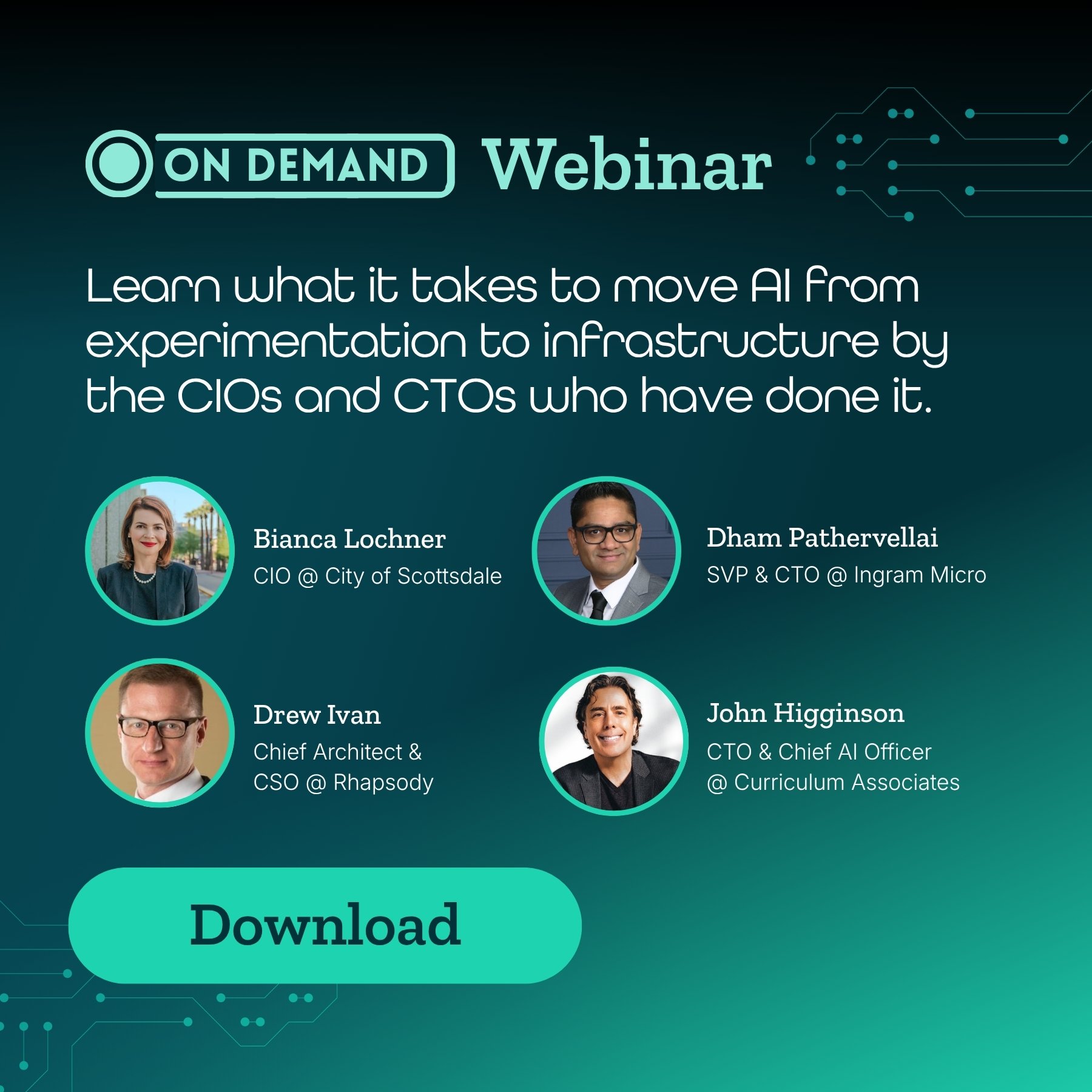
That was the core theme of Yoh’s recent webinar, When AI Becomes Infrastructure: How Technology Leaders Embed Intelligence Business Performance. Moderated by Yoh’s VP of Digital Transformation, Mike Dachenhaus, the discussion brought together leaders from the public sector, healthcare technology, education, and global distribution to talk candidly about what it takes to move AI from a promising idea to operational reality.
Below, we’ve pulled together a few of the key takeaways. If you’re curious how the full conversation played out, you can access the download here.
One of the clearest points from the conversation was that AI does not create value simply because a company is experimenting with it.
As Dham Pathervellai, SVP & CTO at Ingram Micro, put it: 95% of AI initiatives die in pilot… If AI is not operationalized, it’s not a strategy. It's just another noise.”
What separates the winners is not the technology itself. It is whether the organization can connect it to daily business functions that support how work gets done, and show a measurable financial outcome.
At Ingram Micro, that meant moving from proof of concept to production with an intelligent data system that now drives proactive sales engagements at scale. For Bianca Lochner, CIO at the City of Scottsdale, the focus has been on working AI into the flow of daily operations. That includes helping staff pull information faster across disconnected systems, identifying unlicensed short-term rentals, and supporting faster response in public safety.
Key Takeaway: AI is most valuable when it is built into the way work already happens.
There’s a tendency to look for big, visible wins with AI. New products. New experiences. Something that feels transformative. But that’s not where most organizations are seeing traction.
As Lochner shared, some of the most meaningful impact comes from what many would consider “unsexy” use cases. Things like helping staff find information faster, reducing manual review work, or improving how data moves between systems. “Individually, those might seem like incremental improvements, but at scale they really make gains in efficiency, safety, and public service delivery.”
Drew Ivan, Chief Architect & CSO at Rhapsody, made a similar point. A lot of teams begin by using AI to move faster on things they already do, like drafting emails or summarizing content. That’s a good starting point, but it’s not where the real value sits.
The better question is: What are we not doing today because we don’t have the time or capacity?
That’s where AI starts to open new possibilities.
Key Takeaway: The most valuable AI use cases often start as small, operational improvements that scale over time.
Another theme that came up quickly: AI doesn’t fix broken processes.
John Higginson, CTO and Chief AI Officer at Curriculum Associates, pointed out that many organizations expect AI to act like a shortcut. Add it on top of existing workflows, and things improve automatically.
In reality, if decision-making is unclear or processes are overly complex, AI tends to expose those issues rather than solve them.
Organizations that are seeing progress are doing both at the same time. They are introducing AI while also rethinking how work flows, how decisions get made, and where unnecessary steps can be removed.
AI doesn’t remove the need for strong talent. If anything, it raises the bar.
Ivan noted that demand for experienced AI professionals still far outweighs supply. That creates two challenges. First, it’s harder to identify who actually has hands-on experience versus who simply understands the surface. Second, the right AI talent often comes at a premium.
But the cost of getting it wrong is higher.
As Higginson put it, the bigger challenge isn’t just hiring experts. It’s building momentum inside the organization:
“The first step is finding people who are really excited about [AI], who become the evangelists inside the company. The people who want to pick it up, try it, experiment with it… Those people become both the teachers of how to use AI and the ones who reveal what’s possible.”
From there, that momentum has to be reinforced at the top:
“It has to be top down… You have to tell people we’re going in this direction, we're going to use these tools, we're going to give you the licenses, and we're going to remake these workflows with AI. That’s just non-negotiable.”
Key Takeaway: Strong teams don’t rely on one expert. They build a mix of internal champions, leadership direction, and clear ownership as AI becomes part of how the organization operates.
There’s no single model for how organizations should approach AI training.
Some level of structure is necessary. Tools, access, and support need to be in place. But beyond that, teams often need the flexibility to figure out what works within their own roles and workflows.
Lochner talked about this in a very practical way. Instead of running broad training sessions, her team shows people where AI fits directly into the work they’re already doing.
That makes a difference. It changes how people see it. It stops feeling like something abstract or threatening and starts to feel useful.
Key Takeaway: Upskilling works best when it’s grounded in real workflows and supported by a culture that encourages experimentation.
AI doesn’t scale on its own.
At Rhapsody, Ivan described how it had to be led from the top. Not just talked about, but built into how the company runs. That includes goals, hiring decisions, and how performance is measured.
At the same time, governance needs to be established early.
Pathervellai warned that without it, “shadow AI” becomes a real issue. Teams start using different tools, data moves in uncontrolled ways, and risk increases quickly.
Organizations that are further along are putting structure in place up front. Clear policies, defined ownership, and centralized oversight help ensure AI is used responsibly and consistently.
Key Takeaway: AI adoption requires both strong leadership alignment and clear governance from the start.
A final point that tied everything together: AI doesn’t need to reinvent the business to be valuable. In many cases, the biggest impact comes from improving how work already happens. AI acts as a force multiplier when it’s embedded into day-to-day workflows. It helps people make decisions faster, reduces guesswork, and increases speed to market without changing the core business model.
Across every perspective shared in the discussion, the pattern was consistent. The organizations making progress are not chasing AI for its own sake. They’re focused on where it fits, how it holds up inside workflows, and what it actually delivers once it’s in production.
If you’re working through those same questions, the full conversation is worth a watch.
Watch the webinar recording to hear how these leaders are approaching AI adoption, operationalization, and scale in real environments.
%20Size%20Photos/iStock-504287804%20(1).jpg?width=382&name=iStock-504287804%20(1).jpg)
The 2025 CWS Summit North America is right around the corner. From September 8 to 9, workforce...
August 12, 2025
/Specialty%20Practices%20Stock/IT%20and%20Engineering%20Stock/GettyImages-866661314.jpg?width=382&name=GettyImages-866661314.jpg)
AI adoption presents a huge opportunity for organizations, but it's not without its challenges....
January 30, 2025
%20Size%20Photos/GettyImages-1182697690.jpg?width=382&name=GettyImages-1182697690.jpg)
'Searches for generative AI jobs on Indeed have increased almost 4,000% in the last year' according...
February 13, 2024